


Perception versus procurement: what actually decides the wall
Perception still equates concrete with modernity, and earth systems still need visible public and private reference projects to shift that signal. But perception is not what stalls a school programme. Contractors and project managers in Yaoundé rarely lose time because a brochure sounded convincing. They lose time when the wall leaves the line, when mortar consumption exceeds the bill of quantities, or when a delivery cannot be rejected because the purchase order never stated measurable criteria. This piece stays on the practical side of the concrete-versus-earth question for school buildings: what to write, what to check, and what to refuse. Stabilised Earth Blocks (SEB) — local laterite with controlled cement stabilisation for water resistance — are the reference product throughout, but the logic applies to any walling unit.
Why Yaoundé sites expose weak specifications
In Cameroon, and especially in Yaoundé, material decisions sit between site schedules, cement pricing, and performance once the wall is standing. Teams that treat supply as an afterthought discover too late that tolerance, curing, and logistics decide the programme as much as the architectural plan.

Local context matters: high humidity, variable labour skill, congested roads in the rainy season, and a lasting dependence on imported clinker that shows up in bag prices. A serious specification describes not only the product, but minimum cure age, dimensional checks, and rejection conditions at delivery. Without those lines, every dispute becomes a negotiation instead of a measurement.
Rainy-season access also changes the economics of breakage and rework. A load that arrives late and already chipped is not “almost good enough” if the crew must rebuild joints the next morning. Spec language that anticipates transport and stacking protects the calendar, not only the compressive class printed on a datasheet. Interlocking Earth Bricks — dry-stack friendly profiles for low-mortar walls — reduce mortar demand, but only if the units arrive within the dimensional tolerance the profile assumes.
Evidence that belongs on the purchase order
Embassy and pilot housing projects using compressed earth shift the social signal when quality is visible. These points do not replace laboratory testing, but they frame the conversation between client, contractor, and supplier before the first truck arrives. Write them as acceptance criteria, not as marketing adjectives.
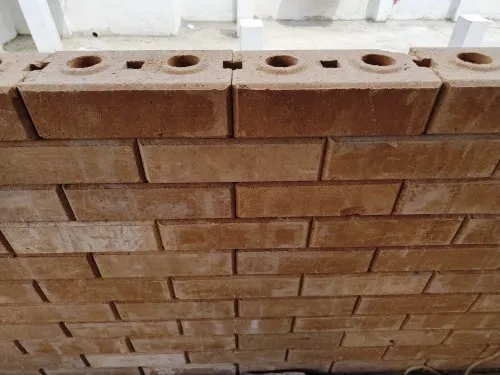
Training of masons matters as much as the block recipe. A crew that has never laid calibrated units will improvise joint thickness until the wall is out of plumb, and no datasheet survives that. Budget for a trial panel — a few square metres laid and checked before full production — and treat it as evidence, not ceremony.
Whole-cost thinking beats unit-price theatre. Mortar overuse, breakage, and rework often erase the savings from a cheaper block. Ask suppliers to state what happens when a pallet fails dimensional checks — replacement lead time matters as much as the rejection itself. If the project involves NGO or institutional funding, auditors will later ask how quality was controlled at delivery, not whether the site “trusted the supplier”. A short acceptance log (date, truck, sample checks, accepted or rejected, signature) is cheap insurance against both structural risk and paperwork disputes.
Site practice: what crews actually check
Clients who visit a finished SEB wall with clean edges often revise cost and comfort assumptions in one meeting. The example is not a universal guarantee; it shows that a written, verifiable requirement changes site behaviour faster than marketing language. Foremen respond to checklists they can enforce at the gate.
Practical rhythm on a disciplined site:
1. Confirm product designation and nominal size against the PO before unloading.
2. Sample dimensions on at least a small random set per load.
3. Quarantine damaged units instead of “using them somewhere unseen”.
4. Keep batch and production references with the site diary.
None of this requires a laboratory van — only a tape, a straightedge, and the will to refuse a bad load.
Labour skill varies. When masons rotate or subcontractors change mid-project, calibrated units and clear joint thickness targets reduce improvisation. Training helps, but geometry that fights the mason guarantees zigzag walls even with experienced hands.
Stacking and curing on site deserve the same seriousness as the plant. Blocks stored in standing water, driven over by vehicles, or laid before they have dried after rain will undo careful purchasing. Nominate a dry storage strip and a single person responsible for release to the masons.
Spec language you can copy onto the PO
Framed as a status question, the issue is not messaging — it is what remains measurable after the first rainy season: wall plumb, joint integrity, absence of water-related defects, and a whole-cost view that includes mortar, breakage, and rework.
Minimum lines worth copying:
- Product designation and nominal dimensions.
- Dimensional tolerance, if claimed.
- Minimum cure age before delivery.
- Compressive class where relevant.
- Visual rejection rules: cracks, broken arrises, contamination.
- Replacement lead time for rejected pallets.
- Named person who signs acceptance on site.
Ambiguity favours the weakest load. Show finished detail, not only sustainability language: edges, plaster, and waterproofing decide trust. Put the requirement on the purchase order, keep batch references, and align site acceptance with the same criteria the plant uses. That is how material quality becomes routine rather than dispute.
Specifying blocks, pavers, or SEB for a Yaoundé site? Browse the NDASI catalogue or message on WhatsApp.